Church presentation platforms now range from lightweight browser tools to full production systems with stage displays, network video, remote control, and multiple independent outputs. Choosing between them depends less on the number of advertised features and more on what a church actually needs during a live service.
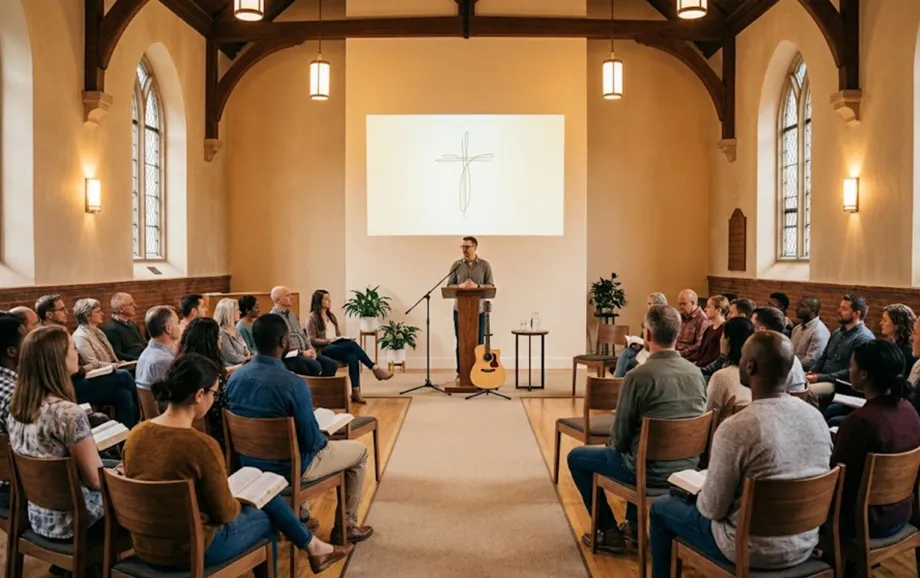
This top 10 church presentation software ranking considers five practical criteria: song and Scripture workflow, live presentation control, media support, technical complexity, and cost. Pricing and product capabilities reflect publicly available information from the providers in 2026.
1. WorshipScreen
WorshipScreen is a browser-based service created by a worship team for church use. It focuses on the content required in a typical service: song lyrics, Bible passages, images, videos, playlists, backgrounds, and timers. Presentations can be shown through a projector or LED screen connected to a computer, while a compatible television can open the presentation through its browser.
Its main advantage is simplicity. No separate desktop application is required, and the service is currently free to use. This makes it particularly suitable for small and mid-sized congregations, volunteer-led media teams, and churches that need one primary presentation output without advanced broadcast integrations.
The limitation is equally clear: teams requiring complex multi-output routing, specialised stage displays, or professional production integrations may need a more advanced platform.
2. ProPresenter
ProPresenter is designed for churches and professional live-production environments that require significantly more control over outputs and media. It supports live editing, multiple displays, stage-screen workflows, media playback, and advanced presentation management. Renewed Vision currently sells new licences on a subscription basis. A single House of Worship seat costs $29 per month or $289 per year, while a campus plan costs $59 per month or $649 per year.
The software is a strong fit for large churches, conferences, and production teams with sophisticated display infrastructure. Its disadvantage is complexity: many smaller congregations will never use enough of its production functions to justify the additional cost and training.
3. EasyWorship
EasyWorship combines song lyrics, Scripture, media, and slide design in a dedicated church environment. The current Basic plan starts at $17.50 per month when billed annually at $210, and the service includes Mac and Windows compatibility, updates, support, and onboarding. EasyWorship also provides access to more than 90 Bible versions across 32 languages.
Its interface is aimed at churches rather than general production teams, which reduces the learning curve for volunteers. The trade-off is an ongoing subscription, particularly when compared with free systems that already cover basic lyrics and Bible presentation.
4. OpenLP
OpenLP is free, open-source church presentation software for macOS, Windows, Linux, and other supported platforms. It can display songs, Bible verses, images, videos, and existing presentation files, while its web remote allows operators to control the service from a mobile browser.
Searchable song and Bible databases are especially useful for churches that want local content management without a subscription. OpenLP also supports prepared orders of service and theme-based presentation styling.
Its interface and setup can feel more technical than streamlined commercial or browser-based alternatives, but the zero-cost model gives technically confident teams considerable flexibility.
5. Proclaim
Proclaim by Logos is built around collaborative church-service preparation. Teams can prepare presentations on Mac or Windows, synchronise their work, manage lyrics and Scripture, and make last-minute changes through presentation tools such as Quick Screens. One subscription covers multiple users within the church rather than requiring a licence for every volunteer.
The platform is particularly useful when pastors, worship leaders, and media volunteers prepare different parts of a service from separate locations.
Its collaborative model is a strong advantage, although churches wanting only straightforward local projection may find the subscription ecosystem broader than necessary.
6. MediaShout
MediaShout is a long-established church presentation application with tools for lyrics, Scripture, media, and service slides. The company currently offers MediaShout for Mac and Windows, with a free 14-day trial available for MediaShout 7.
One attraction is its church-specific workflow rather than a generic slide editor. MediaShout also offers optional paid support and training, including live technical assistance and scheduled training sessions.
It is best suited to churches that prefer a traditional installed application and value access to structured technical support.
7. FreeShow
FreeShow is a free, open-source desktop presenter. It supports church presentations while also targeting general live-presentation use, giving technically capable teams more control than many lightweight free tools.
Its technical feature set includes multiple output streams through NDI, which can be useful when video needs to be sent across a network to software such as OBS or vMix. Ethernet is recommended for this type of workflow.
FreeShow is attractive when a church wants advanced functionality without a licence fee, although its broader configuration options require more setup than a simple browser presenter.
8. WorshipTools Presenter
Presenter by WorshipTools combines song lyrics, Scripture, images, videos, PowerPoint presentations, announcements, and other service content. The base Presenter product remains free, while optional Pro and Pro Plus upgrades add additional functionality. Pro Plus currently costs $29 per month or $295 per year.
For more demanding setups, the published system requirements specify macOS 12 or later, a reliable internet connection, and multiple independent video outputs when extended desktop or Stage Display is used.
This combination of a free entry point and optional advanced features makes Presenter relevant to churches that expect their technical requirements to grow.
9. PowerPoint
PowerPoint remains a workable option when a church already uses Microsoft 365 and primarily needs linear sermon slides, announcements, images, or pre-built lyric decks. Microsoft offers desktop, web, and mobile PowerPoint through different Microsoft 365 plans, while web access is also available within Microsoft’s broader free account offering.
The limitation is workflow rather than slide quality. PowerPoint is a general presentation application, so songs, Scripture, playlists, and spontaneous changes must normally be managed as conventional slides instead of through church-specific libraries and live controls.
For occasional presentations it remains effective. For weekly worship services with frequent song and Bible changes, specialist software is usually more efficient.
10. Canva
Canva is primarily a browser-based design platform rather than dedicated worship software. Its presentation tools include free templates, media assets, online slide creation, and multiple presentation modes, with a free plan currently available.
Its strongest role in a church workflow is content creation. Media teams can prepare announcement slides, sermon graphics, event visuals, title cards, and other assets before exporting or presenting them.
Canva does not replace a dedicated worship presentation system when operators need rapid Bible navigation, reusable song structures, or specialised live-service controls. It is better viewed as a design companion for the presentation workflow.
Church Presentation Software Comparison
The software included in this top 10 church presentation software list is designed for very different technical environments. A useful comparison begins with the operating model rather than the number of advertised functions.
Software | Cost Model | Main Strength | Best Fit |
WorshipScreen | Free | Simple browser workflow | Small and mid-sized churches |
ProPresenter | Subscription | Advanced production and outputs | Large churches and production teams |
EasyWorship | Subscription | Church-focused interface and Bible library | Regular volunteer-led services |
OpenLP | Free, open source | Flexible local presentation tools | Budget-conscious technical teams |
Proclaim | Subscription | Collaborative preparation | Distributed ministry teams |
MediaShout | Paid | Traditional church presentation workflow | Churches wanting installed software |
FreeShow | Free, open source | Advanced free output options | Technically experienced teams |
WorshipTools Presenter | Free with paid upgrades | Scalable church presentation workflow | Growing churches |
PowerPoint | Free/paid Microsoft options | General slide creation | Simple linear presentations |
Canva | Free with paid upgrades | Design and visual content | Sermon and announcement graphics |
No single platform leads in every category. Churches choosing between them should examine four practical factors:
how quickly volunteers can reach a song or Bible passage during a live service;
whether one display or several independent outputs are required;
whether video, network output, or livestream integration is part of the production workflow;
whether the team prefers browser access, local software, or cloud collaboration.
Testing these workflows on the actual church computer, projector, television, or LED system is more reliable than choosing software from a feature list alone.
Final Verdict
The top 10 church presentation software options fall into three broad groups. ProPresenter is better suited to advanced production environments where multiple outputs and professional controls justify a paid subscription. EasyWorship, Proclaim, MediaShout, and WorshipTools Presenter occupy the middle ground, combining dedicated church workflows with varying levels of collaboration and technical depth.
OpenLP and FreeShow provide capable open-source alternatives for teams prepared to manage a more technical setup. PowerPoint and Canva remain useful supporting tools, particularly for sermon slides and visual design, but neither was created around the non-linear demands of live worship.
WorshipScreen takes the opposite approach to complex production software. It concentrates on songs, Scripture, images, videos, playlists, timers, and straightforward live control through a browser. For churches that need these core presentation functions without subscriptions or an extensive production environment, that focused workflow can be more useful than paying for features the team rarely uses.